The prologue is short, but it contains the one branch that changes how far you go toward Brencis. This walkthrough covers what happens in it, the Bad Blood branch, the early decisions that ripple into your build, and where to checkpoint.
What the prologue does
The prologue establishes everything the rest of the game runs on: 1347, the plague-ridden Carpathian territory of Vale Sangora, and Coen, a Dawnwalker — human by day, vampire by night. It introduces the three mechanics that define the whole playthrough: witchcraft in daylight, vampirism at night, and the Blood Hunger pressure that comes with your night side. It also frames the conflict. Brencis sits at the top of it, and Ambrus, Bakir, and Xanthe run the war underneath him. You do not fight the vassals yet — the prologue exists so that when the Vale opens up, you understand what you are walking into.
The pacing is worth knowing in advance: the prologue moves fast, and the day and night cycle is part of it, not something that only starts in the open Vale. You do not get a long safe stretch to experiment. That is exactly why this is the right place to learn the basics — a mistake here costs a reload, not a day.
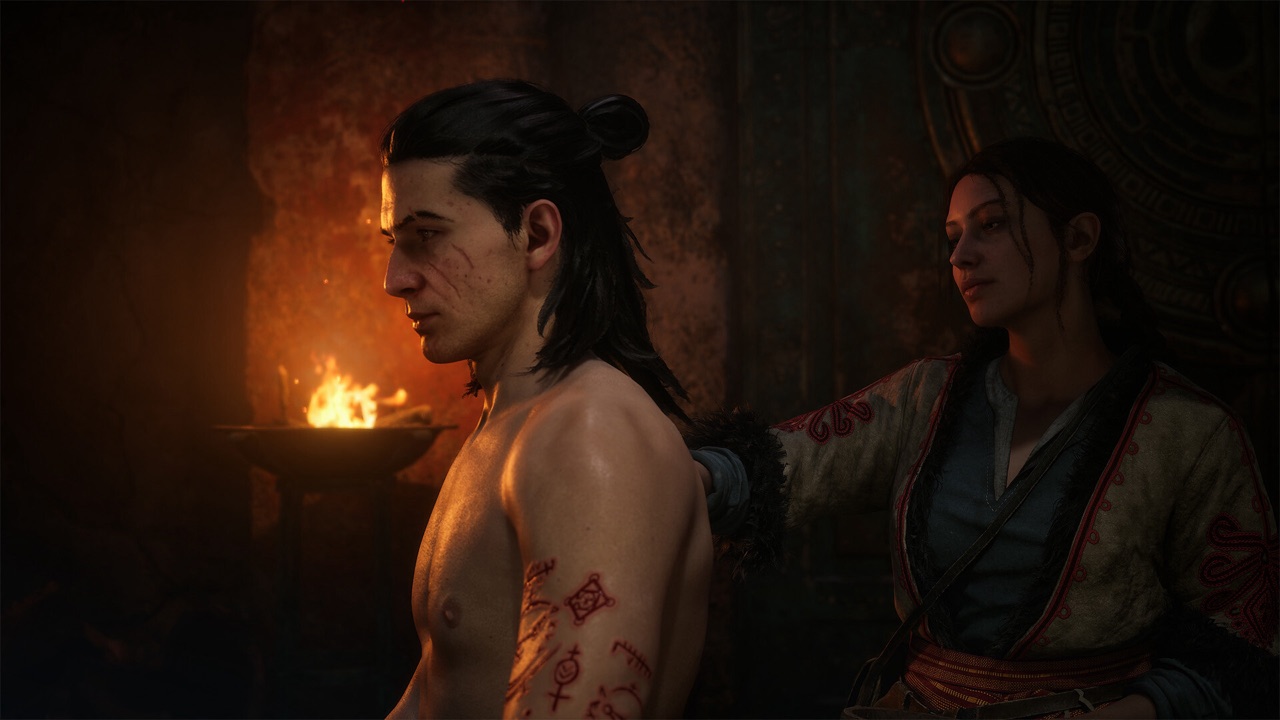
The prologue runs as a separate chapter, which matters for two reasons. It is a scripted, bounded stretch, and it is the only stretch in the game where experimenting costs you nothing.
Confirmed prologue quests and puzzles
The prologue drops you directly into five named quests with specific solutions and choice points. These are not side content — they are the tutorial for the systems that govern the entire 30-day run.
Blasphemy (Banner theft investigation)
Village elder Gremla reports her sacred Banner was stolen. The investigation is a Focus tutorial:
- Find Premysl — the elderly man with a limp and injured hand near the northeast farm
- Footprints behind the shed + blood-soaked cloth strip reveal who took it
- Premysl’s cane and injured hand (visible with Focus) are the evidence that cracks the case
This quest teaches the Focus mechanic, which you will use to spot interactive objects throughout the run. It is also the first chance to practice a non-combat resolution — the banner thief is not killed.
Anca’s Recipe (the medicine puzzle)
Anca asks Coen to prepare medicine for his mother Esme. The correct recipe:
- Hot water + 3 spoonfuls of herbs
Get it right and you skip a redundant second cutscene of Coen fumbling the dose. Get it wrong and you still proceed, but you watch the extra scene — no story penalty, just wasted time.
Force Feed (the mother dilemma)
Coen’s father Pieter pressures him to feed the medicine to Esme, who can barely swallow. Three dialogue options:
- Force the medicine — both paths lead to the same outcome (she cannot keep it down)
- Say “She’s gone to mass before” (an extra option to stall)
- Refuse to force it
⚠ The two main branches resolve identically — neither succeeds in getting the medicine down. The recommendation is to avoid forcing it (it changes tone but not outcome). This is a single-sourced observation — cross-verification is pending.
Anca Latin (the optional detour)
Anca offers to teach Coen Latin for 2 dialogue segments, or he can leave immediately and save the time.
- Stay: 2 segments consumed, Latin skill shown in a later quest option
- Leave: 1 segment consumed, no Latin available
⚠ Launch-day reports indicate this skill has no confirmed downstream benefit — the Latin option appears but does not unlock unique content. Treat it as flavor, not power.
Uriashi (the fishing trip)
A small prologue quest where Coen fishes with a village elder named Uriashi. The quest introduces lore about the old gods and is setup for a later Sanzhana tribe encounter.
The Bad Blood branch
The single most important moment in the prologue is the Bad Blood duel with Brencis — a fight you are supposed to lose. On the default route you lose it, and everything after the prologue builds toward the final confrontation with him. If you beat him instead (in both his forms), the vassal arc is skipped and the run closes with a shorter epilogue.
Why the branch matters
First decisions that matter
- The first night. Blood Hunger arrives before you have any tools for it. The prologue’s lesson is that night is a system, not a state — you need a plan for it before the open Vale, where every night repeats the pressure. The day and night dual-form guide explains the two states in detail.
- Sampling the trees. The prologue lets you touch all three skill trees — Swordmastery, Witchcraft, and Vampirism. Do not commit hard yet; the open Vale is where you pick a primary tree. But notice which one your hands reach for, because that instinct is usually right.
- The cost of conversation. Dialogue burns days. The prologue establishes the rule you will be optimizing for the entire playthrough: every quest and conversation advances the clock. The 30-day timer guide is the reference for how that budget works.
- Combat basics. Use the prologue’s fights to learn the fundamentals before the open world turns every fight into a time investment. The combat basics guide covers what to watch for in your first engagements.
Where to checkpoint
The branch is the one prologue decision you want to be able to stand back from. Before you commit to it:
- Read the key choice timeline if you have an ending in mind, so the branch is a choice rather than a guess.
- If you are unsure, play the default route (lose the fight) — it leaves every ending open — and accept that chasing a specific ending may cost a fresh playthrough later.
- Once you are past the branch, the prologue runs to its end without further permanent decisions — play it out and save your real choices for the open Vale.
Where you land when it ends
You finish at the edge of the open Vale, with the 30-day economy about to become your actual resource. From here the game stops being a sequence and starts being a budget. Next stop: the early game first-act walkthrough.